Exclusion
Aug 16, 2026
Emily was starting to see a pattern.
Each day at lunch, the same groups of children were sitting together. She also noticed a handful of children wandering around the classroom, looking for somewhere to sit. Eventually, they would either end up together or sitting alone. Emily was concerned. She had seen this dynamic before, and she knew that if it was happening at lunch, it was likely extending into the rest of the school day.
After observing the children more closely during the morning work cycle and at recess, she confirmed her suspicions—there was an atmosphere of exclusion beginning to take root. Emily was a veteran teacher, and she knew this was not something to take lightly. Once these social patterns became established in the community, they could become very difficult to reverse.
A day or two later, Emily heard someone crying in the bathroom. When Kara emerged, Emily approached her.
“You seem sad. What happened?”
Typically, Kara was very stoic, but Emily’s warm concern came at just the right moment. Without any further prompting, Kara opened up.
“I can’t do anything right. Grace and Anne refuse to work with me. Every morning they rush to get a two-person table together and tell me they’re working together. I don’t know what happened. Last year, we were all friends.”
Kara burst into tears.
Emily had experienced a similar dynamic a few years earlier, and it had taught her a critical lesson. Without proactive intervention, the situation could quickly get worse, and the dynamic itself could begin to support the very kind of exclusion Kara was experiencing. In that previous situation, it had taken two full school years to rebuild a healthy and supportive classroom community.
Seeing this dynamic creeping into the classroom worried Emily, but her experience had taught her what to do. And now was the time to act, while there was still time.
See The Rest of the Story at the end of this article to find out what Emily did.
Exclusion in a Montessori Classroom
A cornerstone of Adlerian theory of social development is the idea that we, as human beings, are fundamentally motivated to find belonging (“I am accepted and loved”) and significance (“I matter and am important”) within our families and communities. Exclusion is particularly hurtful because it strikes at the heart of these primary social needs. We've all experienced it at some point, whether as children or adults. Exclusion communicates, “You don't belong here.” Few experiences are more likely to leave one feeling inadequate, unwanted, or insignificant.
Creating a social environment in which children experience belonging and significance is critical to healthy development. We know that when children feel connected to their teachers and classmates, they are more likely to be engaged, motivated, and successful at school (Allen et al., 2021; Korpershoek et al., 2020; Roorda et al., 2011). On the other hand, when children experience rejection or exclusion, their sense of belonging suffers, along with their social and emotional well-being and their engagement in school. And when children are consumed by where they fit in socially, it can be difficult to focus on the work in front of them. Research even suggests that social exclusion can affect children’s cognitive performance (Tobia et al., 2017).
Ironically, some of the very same qualities that allow a strong sense of community to take root in a Montessori classroom can also make patterns of exclusion more difficult to resolve. Groups of children often remain together for three years or more, giving them the opportunity to get to know one another very well—sometimes, maybe, a little too well. They know each other's strengths, weaknesses, personalities, habits, and social roles. While this continuity gives children meaningful, true-to-life social experiences and opportunities to develop lifelong relationship skills, it comes with some challenges. When unhealthy social dynamics, such as exclusion, begin to become established, that same continuity can quickly turn from an asset into a liability, as children carry established friendships, reputations, and social dynamics from one classroom to the next.
In smaller Montessori schools, children typically have fewer peers to choose from if friendships become strained or simply change. In these communities there is little opportunity to make different social choices. There is an upside to this, as it requires that children work through difficulties. But it also has a downside, as making new friendships can be a healthy response to a friendship that is no longer working, and without those choices a child may become isolated. I have witnessed this firsthand and experienced the heartbreak of watching an excluded child leave the school in search of a school where there were more peers to choose from.
Next, a Montessori classroom is a hub of activity. Montessori children have the freedom to choose their work partners and playmates and often work together independently. In this active environment, exclusion can develop under the radar. By the time an adult recognizes what is happening, the pattern may already be well established and require focused intervention. This creates a dilemma for adults: how to intervene without taking over the children's social choices? An understandable temptation to increase adult control may arise, but too much control can actually exacerbate the problem by creating resentment, dependence on the adult, or new, more covert forms of exclusion.
There is one more factor to consider: parent responses to exclusion. When parents learn that their child is being excluded, their instinct is, often, to help. They may arrange playdates, encourage particular friendships, strategically organize birthday invitations, or ask the teacher to make sure their child is included. These efforts usually come from a good place, but they also unintentionally draw more attention to the social hierarchy and invite resentment, resistance, or even more covert exclusion. Other times, parents may encourage their child to avoid or exclude children they believe are undesirable. Again, this may come from a good place—protecting their child from someone they believe is being hurtful, or from a difficult friendship—but it can create its own resentment and social divisions. When exclusion becomes part of the classroom dynamic, arranging individual friendships doesn't solve the problem. The work needs to happen within the community, with the children actively involved in finding solutions.
Exclusion Across the Planes of Development
As children move through the planes of development, peer relationships become increasingly important and more complex. Consequently, social exclusion looks different at each stage of development and carries different meaning for the child. Understanding these developmental differences helps us respond appropriately, rather than interpreting every social interaction through the same lens.
Toddlers (ages 0 to 3 years) - During the first half of the first plane of development, true social exclusion is rare. Toddlers typically work alongside rather than with one another and choosing to walk away or work alone not necessarily a social statement. Most often, these behaviors reflect developmental needs, personal preferences and interests, or a growing desire for independence. Adults should therefore be cautious about interpreting toddler behavior through the social lens of an older child.
Children's House (3-6 years) - Around four years of age, friendships begin to take on new importance. Children become more interested in choosing preferred playmates and finding their place within the classroom community. This is often when exclusion first begins to appear. Mostly, however, this reflects developmental immaturity rather than intentional unkindness. A child may feel possessive of a friend, insecure about losing a relationship, or simply prefer playing with one child over another (Rubin et al., 2006; Fanger, Frankel, & Hazen, 2012).
These behaviors are developmentally expected, but they should not be ignored. The Children's House offers countless opportunities to help children develop empathy and learn how to balance their own preferences with the needs of the community. Grace and Courtesy lessons, Class Meetings, simple conflict resolution, and the daily life of the classroom all help children develop the social skills they will need as they move into the elementary years.
Elementary (6–12 years) — The elementary years are when social exclusion can become a more significant issue. As children's social world expands, friendships become based less on proximity and more on shared interests, personalities, and experiences. Children also become much more aware of acceptance, belonging, fairness, and social standing (Rubin et al., 2006).
Much of this is a normal part of development. Friends naturally grow apart as new friendships develop. Children will feel disappointed when they are not invited to a birthday party or playdate, or when a close friend begins spending more time with someone else. Outside activities, neighborhood friendships, and relationships between families also begin shaping children's social world and inevitably find their way back into the classroom.
Exclusion can also be intentional. In the second plane of development, children may form exclusive friendship groups, compete for social status, or use friendship itself as a form of social influence. These behaviors are common, and they can be hurtful. We should not be passive or accepting of hurtful behavior, but neither should we try to prevent every difficult social experience. Children need opportunities to experience disappointment, make mistakes, work through conflict, and learn from their experiences with others. Learning to navigate these social dynamics during middle childhood is much easier than trying to learn them in adolescence or adulthood.
This creates one of the elementary guide's greatest challenges: knowing when to step back and let children work through a normal social difficulty and when to step in because a pattern of exclusion is beginning to take root. The second plane is an important time for children to develop a greater awareness of social order, fairness, morality, and their place within the group. Our role is to help children develop the empathy, problem-solving skills, and courage to navigate these experiences while protecting individual dignity and the well-being of the community.
Adolescence (12-18 years) - Social exclusion does not disappear during adolescence. If anything, it often becomes more painful because belonging is so closely tied to a young person's developing identity. Exclusion may be less obvious than it was in the elementary years, but often more sophisticated. Instead of openly rejecting someone (although it does happen), adolescents may exclude through private group chats, social media, rumors, sarcasm, or simply by leaving someone out of social plans (Rubin et al., 2006).
The encouraging news is that adolescence also brings tremendous opportunities for growth. Adolescents become increasingly capable of empathy, perspective-taking, and moral reasoning. Within a healthy Montessori community, these capacities can be nurtured through meaningful communal work, honest conversations, and authentic responsibility for their community. Our role is no longer simply to help adolescents resolve social conflict, but to help them become the kind of adults who create communities where everyone experiences belonging and significance.
Preparing the Teacher and the Environment
While we will never eliminate children excluding one another, we can intentionally prepare the environment to make healthy social relationships more likely. A lot of what is written about addressing exclusion in school environments focuses on the direct teaching of social (Grace and Courtesy) skills. Teaching social skills is necessary but, alone, insufficient. The adult must also intentionally prepare the social environment so that dignity, respect, belonging, and meaningful participation are supported throughout the day.”
- Avoid Forced Sharing — Requiring children to share a material may be well intentioned, but it doesn't teach generosity. When sharing is forced, it becomes compliance rather than a choice and can create resentment, possessiveness, and conflict. Instead, teach children how to ask, negotiate, wait, and find solutions while respecting their ownership of materials.
Avoid Forced Inclusion — The same principle applies to friendships. Requiring a child to include someone in their social circle doesn't teach friendship; it also teaches compliance. Respect children's freedom to choose their work partners and playmates while intentionally preparing opportunities for them to develop relationships outside their usual friend groups. A common goal or task can create a natural opportunity for connection without requiring friendship or inclusion. - Observe for Patterns of Exclusion - Common changes in behavior that may signal a child is being excluded include playing or working more by themselves, hanging back from other children or their usual group of friends, avoiding school, or asking to quit activities outside of school. Common indicators that children may be excluding others include changes in friendships or friend groups, a child suddenly gaining popularity or influence, turning away from a child or group through body language, physically blocking access to a group, sudden silence when a child or teacher approaches, avoiding eye contact, or creating strict rules about who can be included in an activity or game.
- Provide Limits and Supervision During Free Play - Most Montessori schools allow for free, unstructured play outside, and this is extremely important for supporting creativity, exploration, social skills, independence, problem-solving, and motor skills. It also provides a ripe opportunity for behaviors like exclusion. Too little free play can limit important developmental opportunities, while too much unstructured time can open the door to social aggression (see the Bullying article) and exclusion. During free play, active supervision – making oneself fully present and engaged - is critical. Many social difficulties on the playground can be mitigated simply through active supervision.
- Plan Organized Activities with Children - Rather than planning outdoor games for children, plan them with children. Elementary-aged children naturally begin organizing their own games and activities outdoors, and involving them in the planning process builds ownership, responsibility, and a stronger sense of community. Planned games also provide an alternative to free play for children who choose to participate, helping ensure that everyone has opportunities to be included. They can reduce the likelihood that children will be unintentionally—or intentionally—left out and provide more reserved or passive children with a natural opportunity to become actively involved rather than waiting to be invited by their peers. A great resource for introducing sports, Montessori-style, is Montessori Sports.
- Play Cooperative Games - There has been so much great work done in developing cooperative games that teach life and social skills such as empathy, teamwork, communication, and group problem-solving. Cooperative games are not just for older students; there are numerous resources for children ages 3–6 as well. They give children a structured experience in developing a sense of belonging and significance. Some games are very short and may take only two or three minutes, while others require preparation and time for debriefing, especially with elementary and adolescent students. Two resources worth exploring are The Kieve Book and Cooperative Games and Sports. The great thing about cooperative games is that many can be played both indoors and outdoors.
- Create Community Norms for Out-of-School Social Plans - Hurt feelings are inevitable when children are not invited to a birthday party, playdate, or other social event. Not everyone will be invited to everything all the time. While we cannot eliminate these disappointments, we can help children learn to navigate them with kindness and respect. Together with the children, develop community norms for handling out-of-school social plans. Your role is to bring your experience and perspective while inviting children to think about what is respectful, inclusive, and considerate of others' feelings. Once these norms have been established, share them with parents and let them know they were created collaboratively with the children. For example, decide together how birthday invitations will be distributed—through the mail, electronically, or at school—and what the community's expectations will be for talking about parties or playdates that do not include everyone. Thoughtfully established norms can prevent unnecessary hurt feelings while helping children, parents, and teachers work from the same expectations.
- Family-Style Lunch - Lunch can be another opportunity for exclusion, especially in schools where children eat in their classrooms at small tables that seat only a few children. Conflicts over who sits with whom can quickly overshadow what should be an enjoyable time for the community to share a meal together. If you've been reading these articles, you know how much emphasis I place on Class Meetings. It was a Class Meeting that solved this problem in the school where I worked for 20 years. One year, lunch seating had become a significant source of exclusion, and one of the children put the issue on the Class Meeting agenda. After discussing the problem, the children came up with a simple solution: move all of the tables together and create one long family-style table where everyone would eat together. It was a very long table—but it worked. The laughter returned. Recess improved. Everyone had a place at the table, and children naturally began connecting with classmates they might not otherwise have chosen to sit beside. It was a terrific reminder that when we trust children with real problems, they often come up with solutions that adults never would have considered.
- Model Including Others - “I wonder if anyone will feel left out?” “Who do you think might really enjoy this lesson?” “What about Paul? I bet he would be able to help us with this!” Children watch us closely, and, as Haim Ginott said, “It is my personal approach that creates the climate [in the classroom].”
- Use Class Meetings - One of the greatest strengths of Class Meetings is their ability to take the power out of unhealthy social dynamics through open and honest communication. Exclusion often thrives in silence. When children respectfully discuss who is being left out, how it is happening, and how it affects the community, the unspoken permission that allows exclusion to continue begins to disappear. Instead of focusing on blame, the class comes together to understand the problem, generate solutions, and make agreements about how they want to treat one another. In my experience, the very process of open dialogue, collaborative problem-solving, and shared ownership begins to unravel the knots that hold patterns of exclusion in place. In addition, Compliments and Appreciations helps children practice seeing the strengths and gifts of others, contributing to a more horizontal social structure.
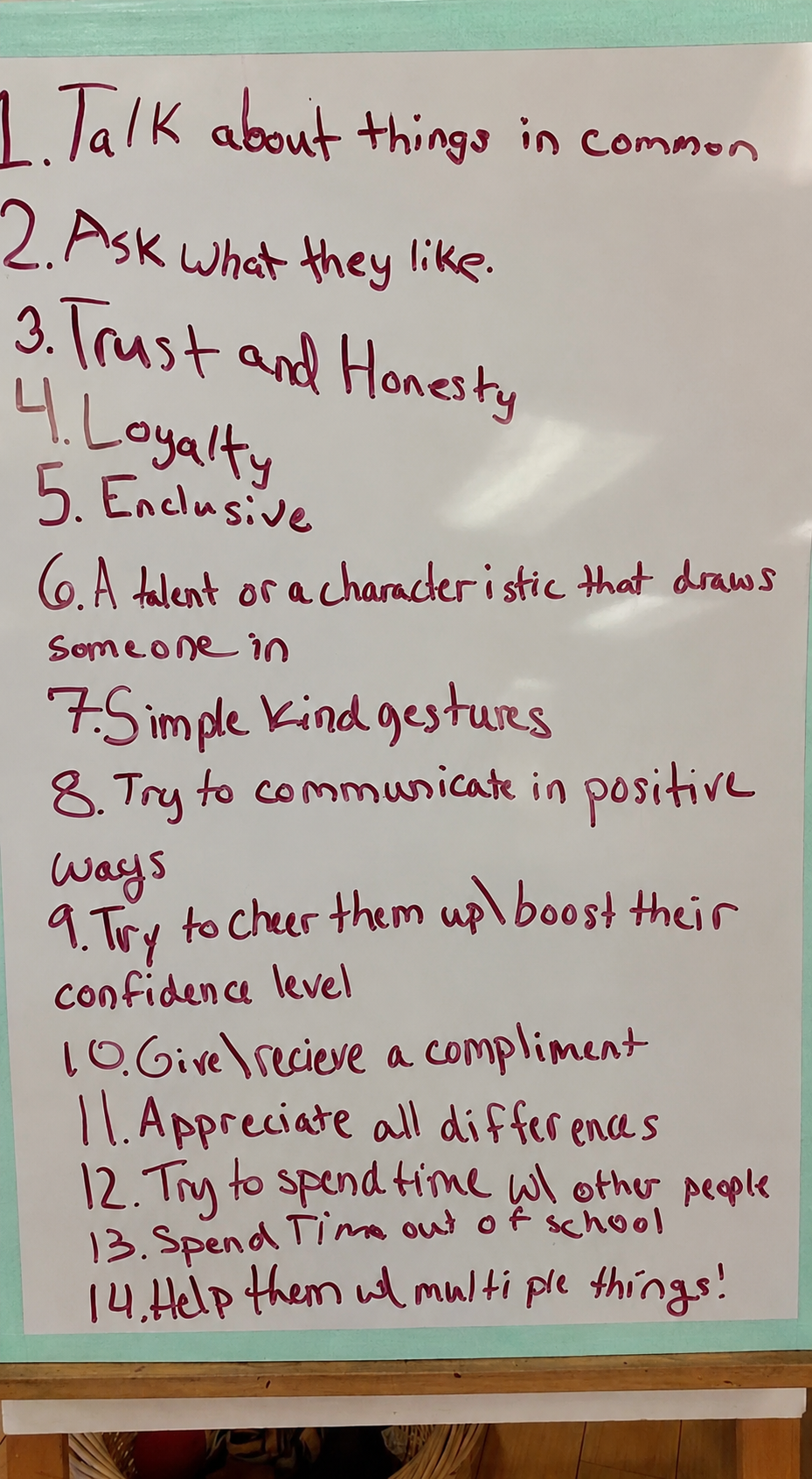
Brainstorming from Emily's Class Meeting on exclusion.
Grace and Courtesy Skills
In a Montessori classroom, children are free to choose whom they work and play with, but they also share responsibility for creating a community where everyone belongs. Maintaining this balance does not mean forcing friendships—“You must play with everyone”—but neither does it mean ignoring exclusion by saying, “It’s their choice.” Our job is to respect children’s freedom while intentionally teaching them the social skills they need to navigate relationships with kindness, confidence, and respect.
- Distinguish Between Choice and Exclusion - Children sometimes feel disappointed when someone chooses to work or play with someone else. That disappointment is real, but it is not necessarily exclusion. During a Class Meeting, ask children if they have ever felt sad when someone chose to work or play with another friend. Then ask if they have ever been intentionally left out. How did those experiences feel different? Help children recognize the difference between someone exercising their freedom to make a choice and someone intentionally excluding another person. Learning to distinguish between the two helps children respond with greater resilience and empathy.
- Navigate Social Boundaries - Freedom of choice includes the freedom to say “no.” Our goal is not to eliminate that choice, but to teach children how to communicate it while preserving relationships. Encourage children to offer an alternative whenever possible: “I’m going to work with Sarah this morning. Would you like to work together this afternoon?” An alternative communicates that the child is choosing a different activity or companion in the moment—not rejecting the other person. At the same time, teach children how to receive a “no” gracefully. During a Class Meeting, brainstorm ways to respond when someone chooses to work or play with someone else. What could you do next? How can you respect the other person's choice while taking care of yourself? Role-play different situations and reflect on which responses preserve both the relationship and each person's freedom of choice.
- Entry Skills - Entry skills may be some of the most overlooked Grace and Courtesy lessons, yet they are essential social skills. Some children are especially sensitive to hearing “no” and may interpret it as rejection. For them, asking, “Can I play with you?” can feel like a very vulnerable question. Rather than assuming children will naturally learn how to join an activity, teach these skills directly and give them opportunities to practice. Help children learn to observe before entering: What are the other children doing? Is this a good time to join? Encourage them to enter through contribution rather than simply asking for permission: “Do you need help setting out the cones?” “Can I build the bridge?” “What are the rules?” or “How did you make the shading on your drawing?” These skills help children become contributors to an activity rather than simply asking to be accepted.
- How to Share a Friend - Respecting a child's freedom to say “no” is an essential part of developing authentic kindness and generosity. But saying “no” isn't the only choice a child can make when someone asks to join. Sometimes welcoming another child may feel inconvenient or even disruptive, but it can also strengthen relationships and build community. During a Class Meeting, invite children to brainstorm the benefits of welcoming someone into their group. What might that look like? When might it be difficult? Role-play their ideas and discuss how these choices can strengthen the classroom community.
- Including Someone Else - Including someone else may seem simple, but it isn't always. Even as adults, inviting someone new into our social circle can feel uncomfortable. Will we have anything in common? Will it change the dynamic? Children have many of the same concerns. Sometimes they simply don't know what to say or do, and it feels easier to stay with the friends they already know. Including someone is a skill that can be taught and practiced. Ask children what makes it difficult and brainstorm ways to make it easier. Role-play simple language such as, “We're making room for one more,” “Would you like to join us?” or “When we're finished, would you like the next turn?” A small invitation can have a tremendous impact on helping another child experience belonging.
- What to Do if You Are Jealous - Jealousy is a normal human emotion, and every child experiences it from time to time. During a Class Meeting, ask the children if they have ever felt jealous. What happened? What were they thinking? What did it feel like? Then ask, “What could you do when you feel jealous instead of acting on those feelings?” Invite children to generate ideas: remind themselves that friends can have more than one friend, ask a friend to work or play together later, welcome another child into the group, find someone else to work or play with, congratulate another child rather than compare themselves to them, or focus on their own strengths and contributions. Help children discover that feeling jealous is not the problem; it is how we choose to respond to those feelings that strengthens—or weakens—our friendships and community.
- Welcoming Visitors and New Community Members - Don't leave welcoming a visitor or new child to chance. During a Class Meeting, invite the children to develop a welcoming plan together. Ask, “What would help someone new feel like they belong?” and “What are some specific things we could do?” Invite children to take on different roles: giving a tour, making a name tag for a cubby, explaining classroom routines, inviting the new child to lunch, or introducing them to classmates. Avoid assigning one child to be a buddy for the entire day. While well intentioned, this can leave the buddy feeling responsible for another child's experience—or resentful because they are being taken away from their own friends and routines. Instead, divide the responsibility into smaller, meaningful roles that allow many children to participate and give the new child opportunities to connect with a variety of classmates. Finally, brainstorm respectful questions children might ask to get to know the new child or visitor without making them uncomfortable.
- Noticing Isolation and Responding with Kindness - Most children will experience loneliness or social exclusion at some point. Our first instinct as adults is often to rescue them, but if a child is in the sensitive period for socialization, it is usually their peers—not the teacher—from whom they are seeking acceptance and belonging. Well-intentioned rescuing can inadvertently communicate that the child needs an adult to create their friendships. Instead, help the children develop the habit of noticing. What might we see if someone is feeling left out or isolated? How might they be feeling? What are some small things we could do? Invite children to generate ideas such as offering a smile, extending an invitation to work or play, sitting with someone at lunch, asking them to work with you, or simply checking in. Belonging is often created through many small acts of kindness rather than one grand gesture.
- Navigating Changing Friendships - Friendships naturally change over time, but children aren't born knowing how to navigate those changes. When a close friend begins spending more time with someone else, it can feel deeply personal and leave a child believing they have lost the friendship forever. Be proactive, especially in the lower elementary years. Use literature and Class Meetings to help children understand that friendships grow, change, and sometimes change again. Invite children to share times when a friendship changed and how they felt. Brainstorm respectful responses when a friend chooses to spend time with someone else. It's OK to feel sad or disappointed. The question is, “What can I do next?” Help children generate solutions such as asking another friend to work or play, inviting the friend to spend time together later, welcoming someone new into their group, or focusing on meaningful work until another opportunity arises. Help children see that changing friendships are a normal part of life and that one friendship does not determine their belonging or significance.
Responding to Exclusion
While the Grace and Courtesy skills suggested above focus on developing social skills in children who are excluded as well as those who exclude, these general responses focus on the misbehavior of children who engage in excluding behavior.
- Avoid Assumptions – Slow down. The first intervention is to observe before responding. Exclusion is one of those behaviors that can bring out a strong emotional reaction in adults, especially when the exclusion appears deliberate. If you need time to cool down, take it. Then seek to understand what happened. Was this a temporary boundary, a request for privacy, or a choice? Or was it intentional exclusion or retaliation?
- State What You Observed – No judgment, just observations. “I noticed James asked to sit with you and walked away looking sad.” “I heard you tell Leah that you wanted to work alone on the Thousand Chain. Now I see that you’re working with Becky.”
- Conversational Curiosity Questions – Become curious. Use Conversational Curiosity Questions to help develop awareness and empathy. Instead of asking, “Why didn’t you let him play?” consider:
- “What were you hoping would happen when _____?”
- “What were you worried about?”
- “What do you think he experienced?”
- “What might she need right now?”
Stay curious and conversational. Remember, setting boundaries can be awkward for children (and adults), and they are not always graceful. If there was an intent to exclude, explore that together.
- Focus on Solutions and Repair vs. Consequences – Exclusion involves a social power dynamic. Imposing consequences may be tempting, especially when a child has been hurt emotionally, but it can invite resentment and lead to more exclusion. Instead, refocus on repair after using Conversational Curiosity Questions: “How might you help her feel like she belongs?”
- Connection Through Contribution – Refocus the child who is excluding others toward making meaningful contributions to the community and serving their peers. Separately, do the same with a child who is being excluded. This gives both children opportunities to experience belonging and significance in ways that are constructive and useful to others.
- Conflict Resolution – Act as a facilitator, not an arbitrator. A well-established and practiced process for conflict resolution gives both students an opportunity to share their experiences, work through the problem, and address their associated feelings constructively.
- Avoid Small-Group Problem Solving – When exclusion is rooted in the social dynamics of the classroom, small-group problem solving is often not the best place to begin, particularly in elementary and adolescent communities. Children do not all hold the same level of social influence, and those differences can unintentionally shape the conversation. Children with less social influence may simply agree with more influential children in hopes of gaining acceptance, while children with greater social influence may—intentionally or unintentionally—continue the pattern of exclusion. As a result, honest problem solving becomes unlikely. Instead, bring the issue to a Class Meeting. The larger community can offer different perspectives, support the children involved, and help develop solutions that strengthen the classroom culture rather than reinforce existing social dynamics.
- Use a Class Meeting – This is one of the most powerful tools a classroom community has for addressing patterns of exclusion. Encourage children who are feeling left out to ask the community for help through a Class Meeting. The earlier the issue is brought to the community, the easier it is to address before patterns become deeply rooted and children become afraid to discuss them because of possible rejection or retaliation. Bringing the problem into the open also takes much of the power out of exclusion, which often thrives in silence and secrecy. A Class Meeting gives the community an opportunity to understand the problem, generate solutions, strengthen relationships, and learn important life lessons together.
Mistaken Goal Responses
“A misbehaving child is a discouraged child.” (Dreikurs & Soltz, 1964)
When children feel supported and encouraged in the classroom environment — when they know they belong and feel significant through responsibility and contribution — they thrive. With guidance, they develop kindness and respect for others and themselves and discover how capable they are.
When children feel discouraged, they misbehave, because they have a mistaken belief about how to belong and feel significant. As Rudolph Dreikurs observed children, he identified four mistaken goals that children adopt when they feel discouraged.
Undue Attention (Notice Me – Involve Me Usefully)
Children whose mistaken goal is Undue Attention may exclude others in an effort to find their place in the classroom community or protect an important friendship. The exclusion is often less about hurting another child than it is about being noticed and involved. The child's mistaken belief may sound like: "If my friend spends time with someone else, there will be less friendship left for me." Or “If I am the center of attention, I will belong.” The belief we are working toward is: “I belong and matter even when my friends spend time with others."
Avoid rescuing, lecturing, or forcing the child to include others. Instead, privately validate the child's desire for connection while teaching healthier ways to preserve relationships. Disrupt active exclusion by asking for a favor. Privately, use Conversational Curiosity Questions to explore what the child was hoping would happen: "Were you worried about losing your time with Mark?" Teach skills such as Sharing a Friend, Offering an Alternative When Saying "No", and Welcoming Someone Else. Create meaningful opportunities for contribution throughout the day so the child experiences belonging without needing to compete for attention. Expect the behavior to intensify temporarily as the child learns that relationships are strengthened through generosity rather than exclusivity. Use a private note, “It looks like Anna is feeling pretty hurt right now.”
Misguided Power (Let Me Help – Give Me Choices)
Children whose mistaken goal is Misguided Power may exclude others to gain influence or power within the real or perceived social hierarchy of the classroom. Exclusion becomes a way of being the one who decides who belongs, controlling access to a group, or demonstrating social influence. The child's mistaken belief may sound like: "I matter when I'm the one who decides who belongs.” The belief we are working toward is: "I can be meaningful when I use my personal power to build community rather than control it."
Connection before correction – build trust and show trust when the student is not misbehaving. Avoid arguing, demanding inclusion, or engaging in power struggles. Address the problem directly and privately by removing the audience. If you feel angry, be honest, take a break and reengage with the child later. “I’m feeling angry right now because Caleb is hurt. I will come and talk with you when I’m feeling calm.” Later, use Conversational Curiosity Questions to help the child reflect on the impact of their choices. Problem-solve together, and follow-through with Presence, Warmth and Silence if the child breaks the agreement. Bring patterns of exclusion to a Class Meeting where the community—not the teacher—can help develop solutions. Share power appropriately by offering legitimate leadership opportunities that focus on helping others rather than directing them – start with them taking charge of tasks and then later leading others. Teach the child that true leadership creates belonging rather than determining who belongs.
Revenge (I'm Hurting – Validate My Feelings)
Children whose mistaken goal is Revenge may exclude others because they feel hurt, rejected, embarrassed, or betrayed. Exclusion becomes a way of saying, "I'm going to make you feel what I felt." The belief we are working toward is: "My hurt matters. I can express it, solve problems, and repair relationships without hurting others."
Focus on establishing trust and connection, you’ll need to draw on this when correction is needed. Avoid punishment, public correction, or forced apologies. Avoid punishment or retaliation and take a break if you feel angry. Act don’t talk. Allow natural consequences. Make amends if you have reacted strongly yourself. Use I Language when talking with the child. First uncover and validate the hurt beneath the behavior using Reflective Listening. Once the child feels understood, collaborate on ways to repair the relationship and restore belonging within the community. Use Conversational Curiosity Questions after emotions have settled, and whenever appropriate, invite the child to seek the support of a Class Meeting.
Assumed Inadequacy (Don't Give Up on Me – Show Me a Small Step)
Children whose mistaken goal is Assumed Inadequacy may exclude others before they themselves can be rejected. Rather than risking vulnerability, they create distance by ignoring, withdrawing (a very powerful form of exclusion), or passively preventing others from joining them. Their mistaken belief may sound like: "If I don't let you in, you can't reject me first." The belief we are working toward is: "I am capable of building friendships, and I belong even when I am not perfect."
Avoid labeling the child as shy, unfriendly, or unkind. Instead, increase encouragement, provide structured opportunities for successful peer interactions, and explicitly teach social skills such as Entry Skills, Welcoming Someone Else, Giving a Compliment and Offering Help. Teach social skills privately and practice them together. Show faith in their ability. Focus on strengths and redirect them to use their strengths to help others. Avoid being “kind only”, instead be firm and kind. Notice and acknowledge even small moments of connection, contribution, and courage. Use Conversational Curiosity Questions to gently uncover the fears beneath the behavior and support the child in taking small steps toward connection.
The Rest of the Story
After Kara broke down with Emily, Emily quietly asked her to help with something in the library. She knew Kara was embarrassed and didn’t want to be seen being “taken care of” by the teacher. Asking her to help gave Kara a way to save face while also moving to a more private space.
Once in the library, Emily asked Kara if she would help shelve some of the books in the return bin. Kara agreed. After a few minutes of simply putting books away, Emily looked over at Kara and gave her a warm smile.
“Thank you. I needed to get out of there, but I didn’t want them to see how upset I was.”
“I know,” said Emily warmly. “What happened?”
Kara opened up while Emily listened. Apparently, Anne and Grace had spent a lot of time together over the summer. Their parents had become friends, and the two families had even gone camping together. Kara, on the other hand, had been busy with gymnastics camp, both as a participant and as a counselor-in-training. Over the summer, Anne and Grace had become close.
Kara felt powerless. The three girls had been an inseparable trio the year before, and now she was on the outside looking in—or at least that’s how she felt.
“Kara, I know you and Grace have been friends since you were both in the Children’s House. That must hurt.”
“Yeah, that seems like so long ago. Now she hates me,” said Kara.
“I know it feels that way,” Emily replied. “I wonder what Grace might be feeling about the situation?”
“Well, I don’t really think she hates me. It just hurts that she only wants to be with Anne, and they exclude me,” Kara replied.
“I wonder if anyone else in our classroom has felt excluded,” Emily mused.
“Yes. It’s happening with other people, too.”
“Would you like to put it on the Class Meeting agenda?” Emily asked. “If it’s happening to other people, I bet it might help everyone to see if we can figure this out together.”
“I can do that,” Kara responded.
She left and added the problem to the Class Meeting agenda.
The following week, Kara’s problem came up at the meeting. She talked about how hurt she was and how she had noticed that other people were being excluded, too. They were, and many of the children took the opportunity to talk about what it felt like. Others talked about how difficult it was to navigate changes in friendships.
Emily knew the power of the Class Meeting, but that day was particularly special. While she had observed some of the exclusion, she realized that it was more widespread than she had understood, much of it very subtle.
The children brainstormed many ideas for addressing the problem, some of which you can see in the photo below. But this was one Class Meeting where it wasn’t a single solution that created positive change; it was the openness of the discussion itself. In the end, the children didn’t choose a single solution. Instead, they used the ideas as a suggestion board for how to treat one another and how to help each other find belonging.
Over the next few months, things gradually improved. In addition to the Class Meeting, Emily worked with the students on specific Grace and Courtesy Skills: how to kindly ask for privacy or time with a friend, how to ask to join, how to receive a “no,” and how to move beyond saying “no.” The class also revisited and role-played conflict-resolution skills focused on exclusion—how to communicate, how to listen, and how to focus on solutions.
At the end of the year, Emily reflected, “In hindsight, I’m so glad I had that experience with the other group a few years ago. I wouldn’t want to go through that again. I tried to fix everything myself—giving lectures and trying to control social situations. When that didn’t work, I resorted to giving consequences. It was a disaster. But it taught me a huge lesson: problems like this can’t truly be solved by the adult alone. We need the children’s participation if we want to create meaningful change.”
References
Allen, K. A., Kern, M. L., Rozek, C. S., McInerney, D. M., & Slavich, G. M. (2021). Belonging: A review of conceptual issues, an integrative framework, and directions for future research. Australian Journal of Psychology, 73(1), 87–102. https://doi.org/10.1080/00049530.2021.1883409
Buhs, E. S., Ladd, G. W., & Herald, S. L. (2006). Peer exclusion and victimization: Processes that mediate the relation between peer group rejection and children's classroom engagement and achievement? Journal of Educational Psychology, 98(1), 1–13. https://doi.org/10.1037/0022-0663.98.1.1
Dreikurs, R., & Soltz, V. (1964). Children: The challenge. Hawthorn Books. (Adams Marmot)
Fanger, S. M., Frankel, L. A., & Hazen, N. (2012). Peer exclusion in preschool children's play: Naturalistic observations in a playground setting. Merrill-Palmer Quarterly, 58(2), 224–254. https://doi.org/10.1353/mpq.2012.0007 (Digital Commons WSU)
Korpershoek, H., Canrinus, E. T., Fokkens-Bruinsma, M., & de Boer, H. (2020). The relationships between school belonging and students' motivational, social-emotional, behavioural, and academic outcomes in secondary education: A meta-analytic review. Research Papers in Education, 35(6), 641–680. https://doi.org/10.1080/02671522.2019.1615116
Mulvey, K. L., Boswell, C., & Zheng, J. (2017). Causes and consequences of social exclusion and peer rejection among children and adolescents. Emotional & Behavioral Disorders in Youth, 17(3), 71–75. (PubMed Central (PMC))
Roorda, D. L., Koomen, H. M. Y., Spilt, J. L., & Oort, F. J. (2011). The influence of affective teacher–student relationships on students' school engagement and achievement: A meta-analytic approach. Review of Educational Research, 81(4), 493–529. https://doi.org/10.3102/0034654311421793
Rubin, K. H., Bukowski, W. M., & Parker, J. G. (2006). Peer interactions, relationships, and groups. In N. Eisenberg (Ed.), Handbook of child psychology: Vol. 3. Social, emotional, and personality development (6th ed., pp. 571–645). John Wiley & Sons.
Tobia, V., Riva, P., & Caprin, C. (2017). Who are the children most vulnerable to social exclusion? The moderating role of self-esteem, popularity, and nonverbal intelligence on cognitive performance following social exclusion. Journal of Abnormal Child Psychology, 45(4), 789–801. https://doi.org/10.1007/s10802-016-0191-3 (PubMed)